Free to print. Choose A3 landscape, or save as PDF from the print dialog.
A field guide for the bench · tomstewarthickory.org
Reading the cleek marks of Tom Stewart, St Andrews
Marks, face patterns and the honest limits of dating. Periods overlap; nothing here should be read as a single settled year. When two readings conflict, the club in the hand wins.
The serpent
c. 1893 – c. 1905A small coiled serpent struck beneath the arc of lettering, on heads made before the pipe became the workshop's signature.
- — Sits high on the back, close under the arc rather than behind the hosel
- — Almost always paired with a smooth face and a long, thin blade
- — Lettering is finer and more crowded than on later heads
Caution: Genuinely scarce. A serpent on a heavy, short, dot-punched 1920s blade is the wrong mark on the wrong club.
The small pipe
c. 1905 – early 1920s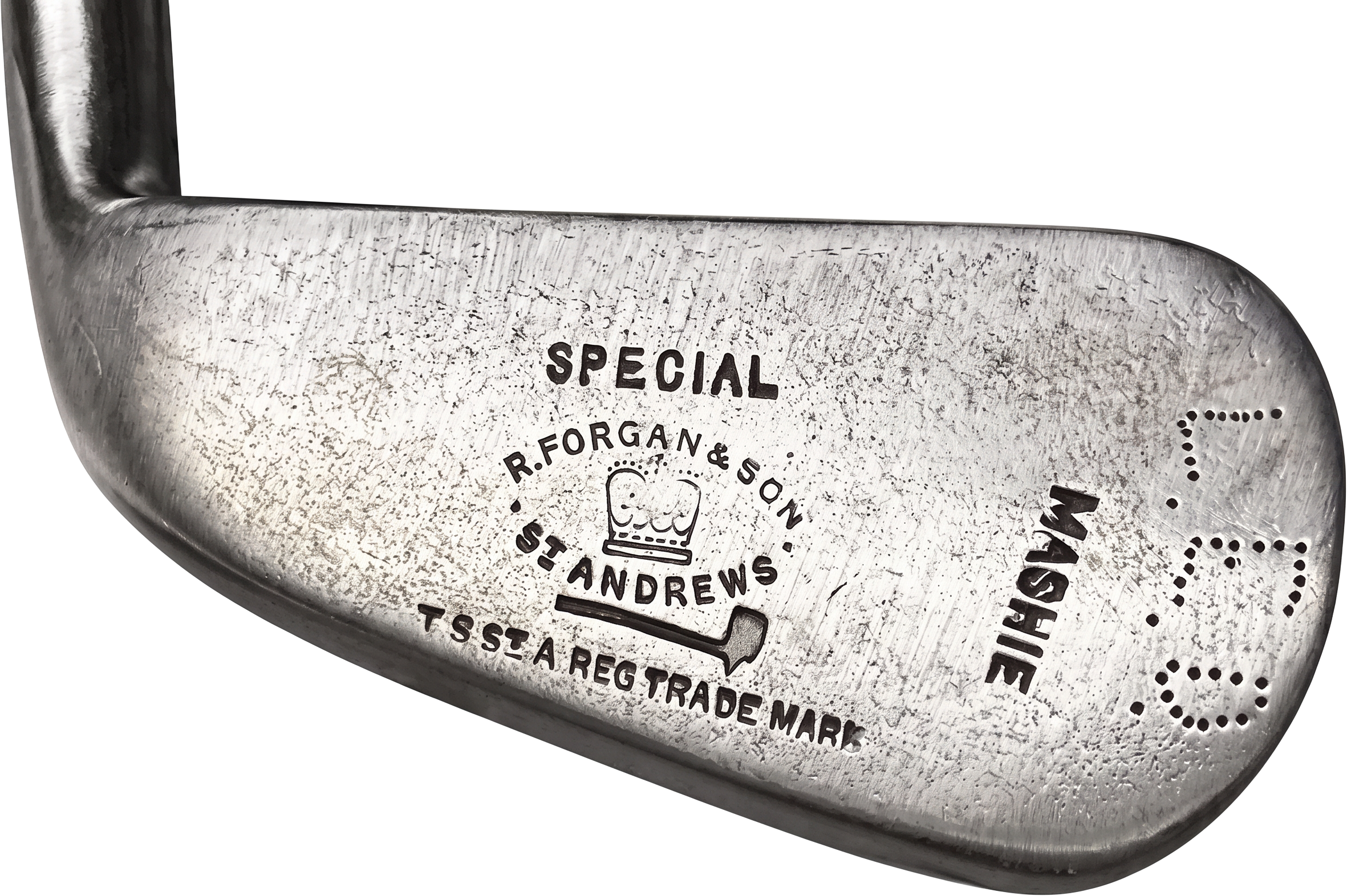
A briar pipe in profile, bowl roughly the width of a match head, stem running to the right. The mark most collectors mean when they say 'pipe brand'.
- — Bowl small and shallow; the stem is the first part to wear away
- — Struck behind the hosel, usually with a hand-punched bench digit below
- — Commonly found with smooth or lightly dot-punched faces
Caution: Bowl size is the reading, not stem length. A worn stem tells you nothing; a small bowl on a low strike does.
The large pipe
c. early 1920s – 1931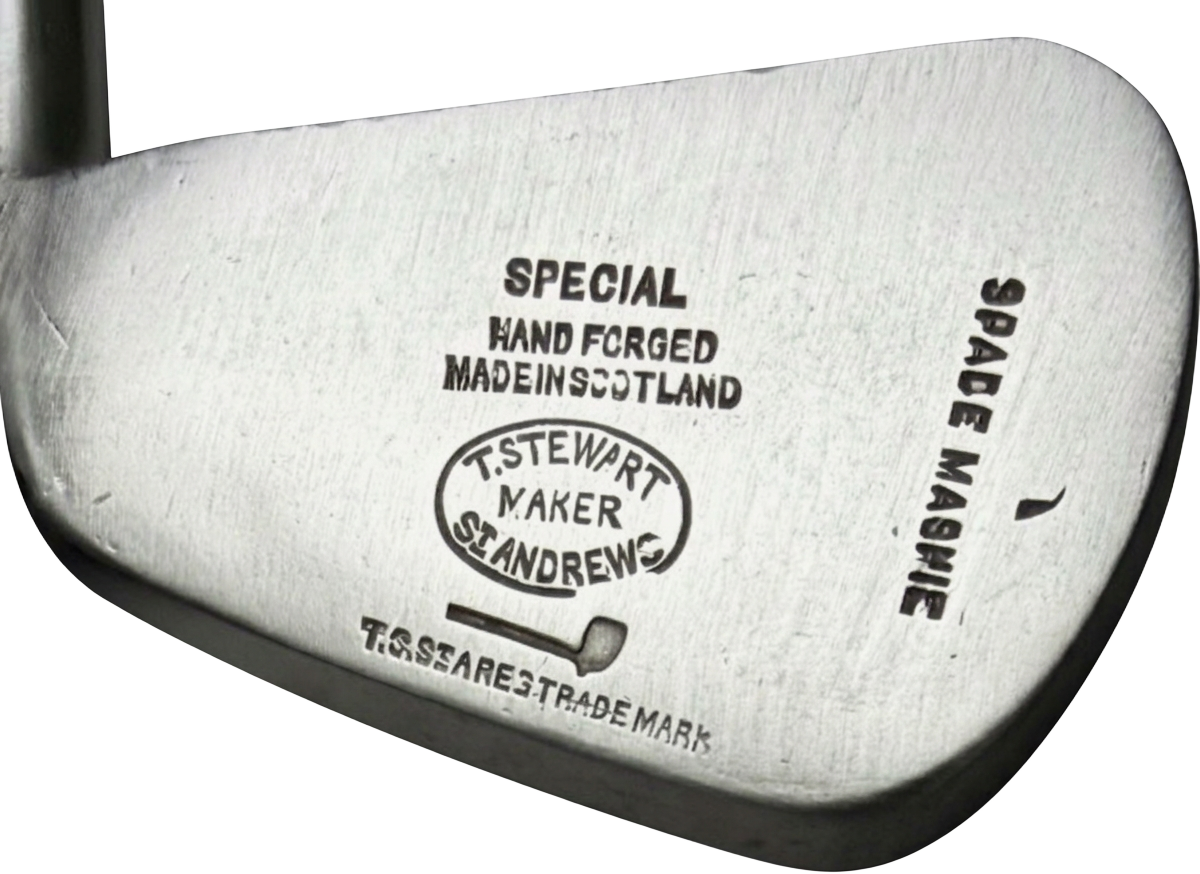
The same pipe, noticeably bigger — bowl nearer the size of a pea — and set lower and further from the hosel.
- — Deeper, broader strike that survives polishing better than the small pipe
- — Frequently accompanied by 'Rustless' on stainless heads
- — The mark on the great majority of surviving Stewart irons
Caution: The changeover was gradual and the two overlap. Treat any single-year dating from the pipe alone as a guess. Received dating here is disputed.
T. Stewart · Maker · St Andrews
Throughout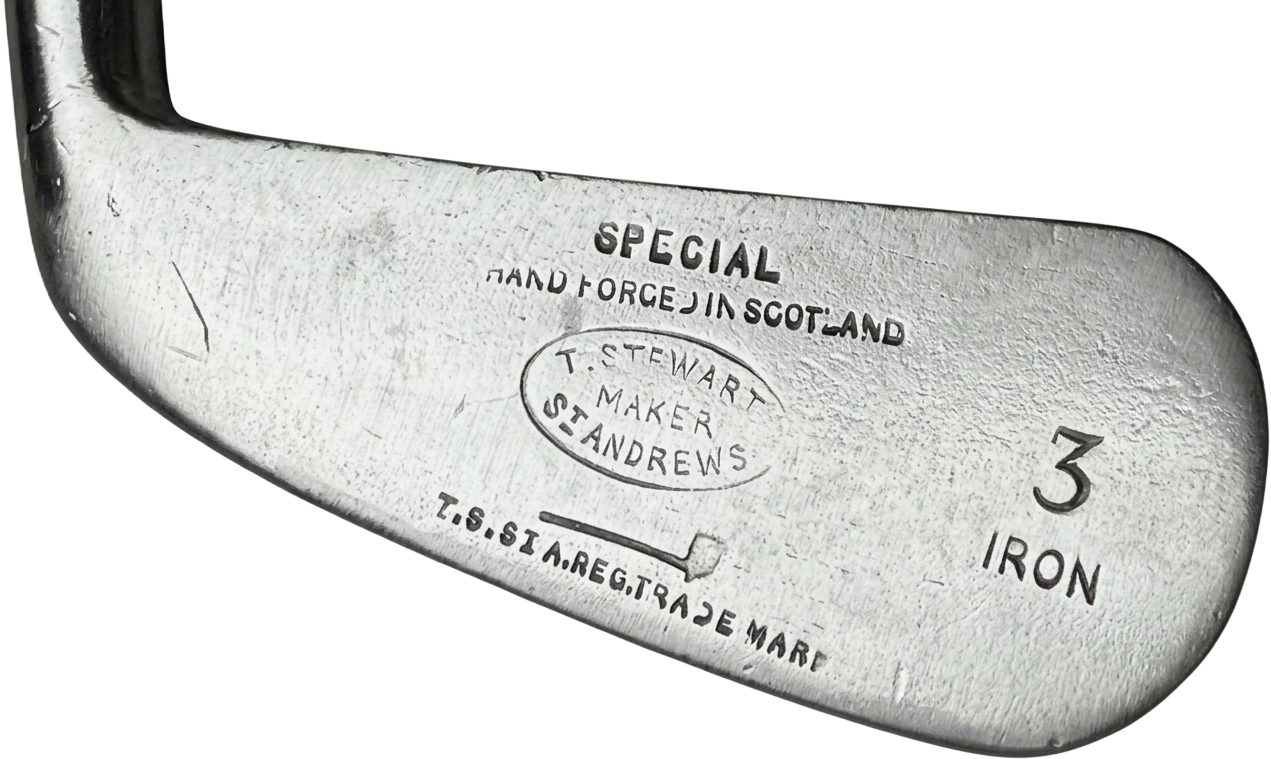
The maker's arc, struck letter by letter above the pipe. On worn heads it survives as a faint curve of disturbed grain.
- — Individual letters sit at slightly different depths and angles — this is hand work
- — Reads cleanly under low raking light, badly under a bright lamp
Caution: Perfectly even lettering at a uniform depth is a machine, and a machine means somebody recent.
Rustless
c. mid 1920s – 1931Stamped below the large pipe on the workshop's stainless heads.
- — Bright metal with little or no pitting after a century
- — Almost always paired with the large pipe and a plain line face
Caution: Condition here is alloy, not care. Do not pay a preservation premium for something the steel did by itself.
Retailer stamps
Throughout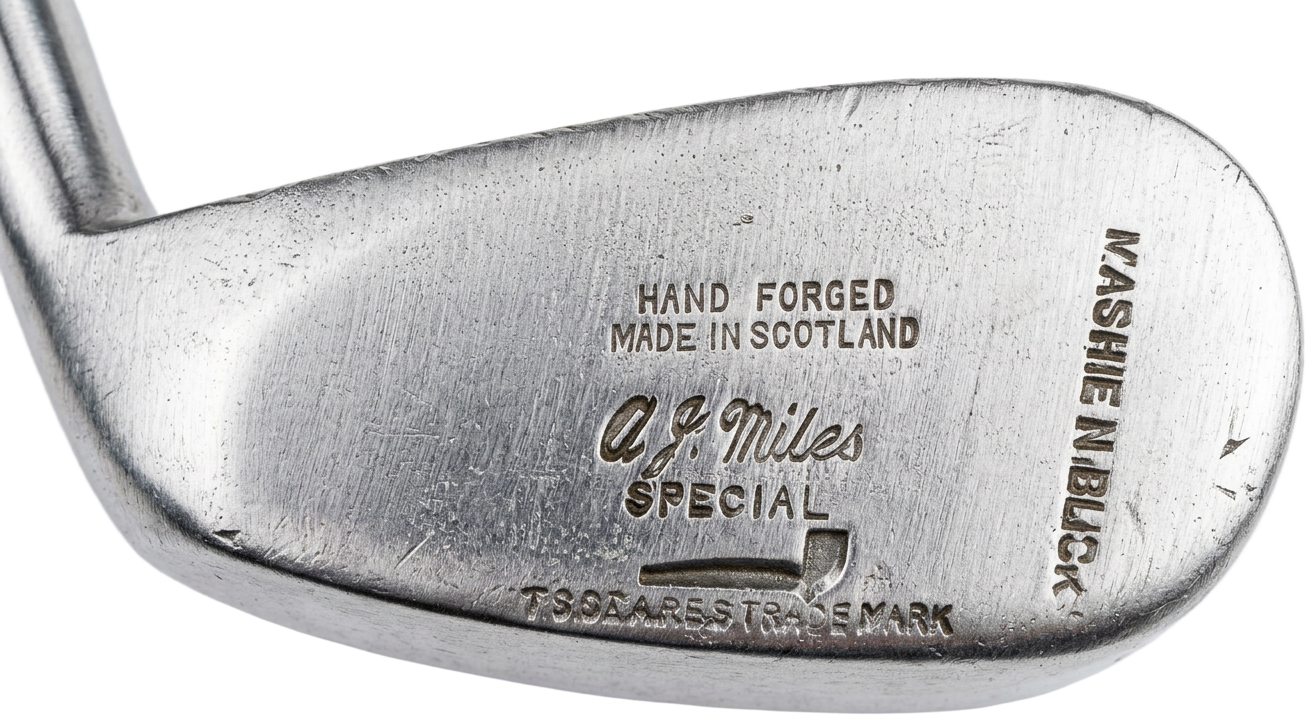
Auchterlonie, Anderson, Spalding, MacGregor, Wright & Ditson and dozens of professionals' shops, arced across the back of a Stewart head.
- — Retailer name and maker's pipe sit beside each other, both original depth
- — This is the normal case: Stewart sold heads to the trade by the crate
Caution: Be wary when a shop name is struck over the pipe, or struck shallow on an otherwise worn head.
Bench numbers
ThroughoutOne or two hand-punched digits below the pipe.
- — Consistent hand and angle across a genuine matched set
- — Wandering digits usually mean a set assembled from several sources
Caution: Widely read as bench, die or weight-run numbers rather than serial numbers. That reading is consensus, not documented fact. Received dating here is disputed.
Face patterns
Smooth → dot & corrugated → lineSmooth into the 1900s, dot punching and deep corrugations through the late 1910s and early 1920s, plain lines after the governing bodies restricted deep grooves.
- — Original punching is worn hollow in the strike zone and sharp at the toe
- — Face pattern brackets a date more reliably than most people's pipe reading
Caution: A crisp, evenly cruel deep-groove face is usually a modern re-cut. Run a fingernail across it.