Field guide
How to identify a Tom Stewart club
Seven checks, in the order a collector actually makes them, using the marks and stamps photographed in the archive. Everything here brackets a date — nothing here proves one.
The short answer
A Tom Stewart iron is identified by the small briar pipe struck behind the hosel, usually under an arc reading T. Stewart · Maker · St Andrews. Bowl size roughly separates pre-1920s (small pipe) from 1920s heads (large pipe), and the face pattern brackets the date more reliably than the pipe does. A retailer's name above the pipe is normal, not suspicious.
Step 1
Turn the head to the light
Marks read best in low, raking light. Turn the head against the light rather than moving the light across the head. A bright overhead lamp flattens everything you are trying to see. Clean the back with a dry cloth only — never a wire wheel, which erases the evidence you are hunting.
T. Stewart · Maker · St Andrews · Throughout
- —Individual letters sit at slightly different depths and angles — this is hand work
- —Reads cleanly under low raking light, badly under a bright lamp
Watch for: Perfectly even lettering at a uniform depth is a machine, and a machine means somebody recent.
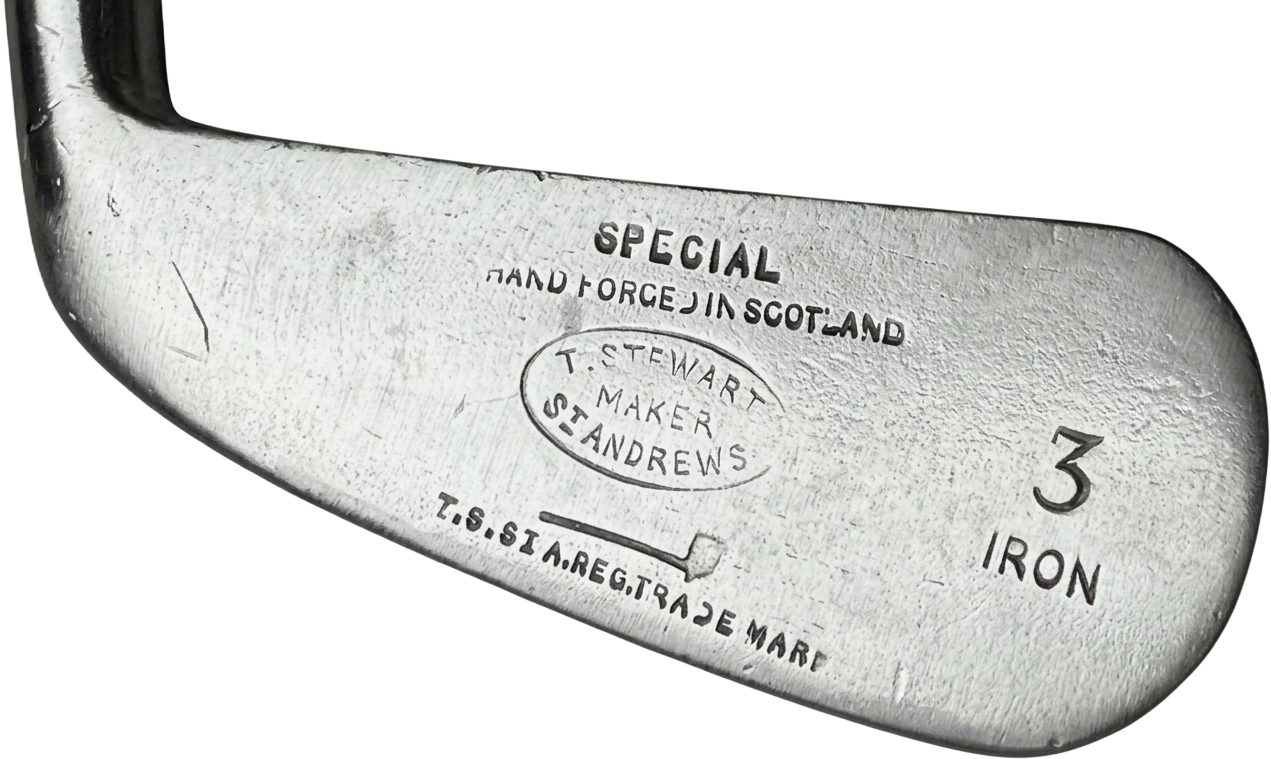
T. STEWART · MAKER · ST ANDREWS in the oval, SPECIAL and HAND FORGED IN SCOTLAND above, the pipe below. A 3 iron from my own bag. Tom Stewart “Special” No. 3 Iron, St Andrews, circa 1920–1925. A hand-forged Scottish hickory iron bearing Stewart’s registered pipe cleek mark, produced as golfers began moving from traditional club names toward numbered matched sets. Step 2
Find the pipe
The pipe is Stewart's signature: a briar pipe in profile, bowl to the left, stem running right, struck behind the hosel. Judge the bowl, not the stem — the stem is the first thing to wear away. A small, shallow bowl points early; a broad, deep bowl points to the 1920s.
The small pipe · c. 1905 – early 1920s
- —Bowl small and shallow; the stem is the first part to wear away
- —Struck behind the hosel, usually with a hand-punched bench digit below
- —Commonly found with smooth or lightly dot-punched faces
Watch for: Bowl size is the reading, not stem length. A worn stem tells you nothing; a small bowl on a low strike does.
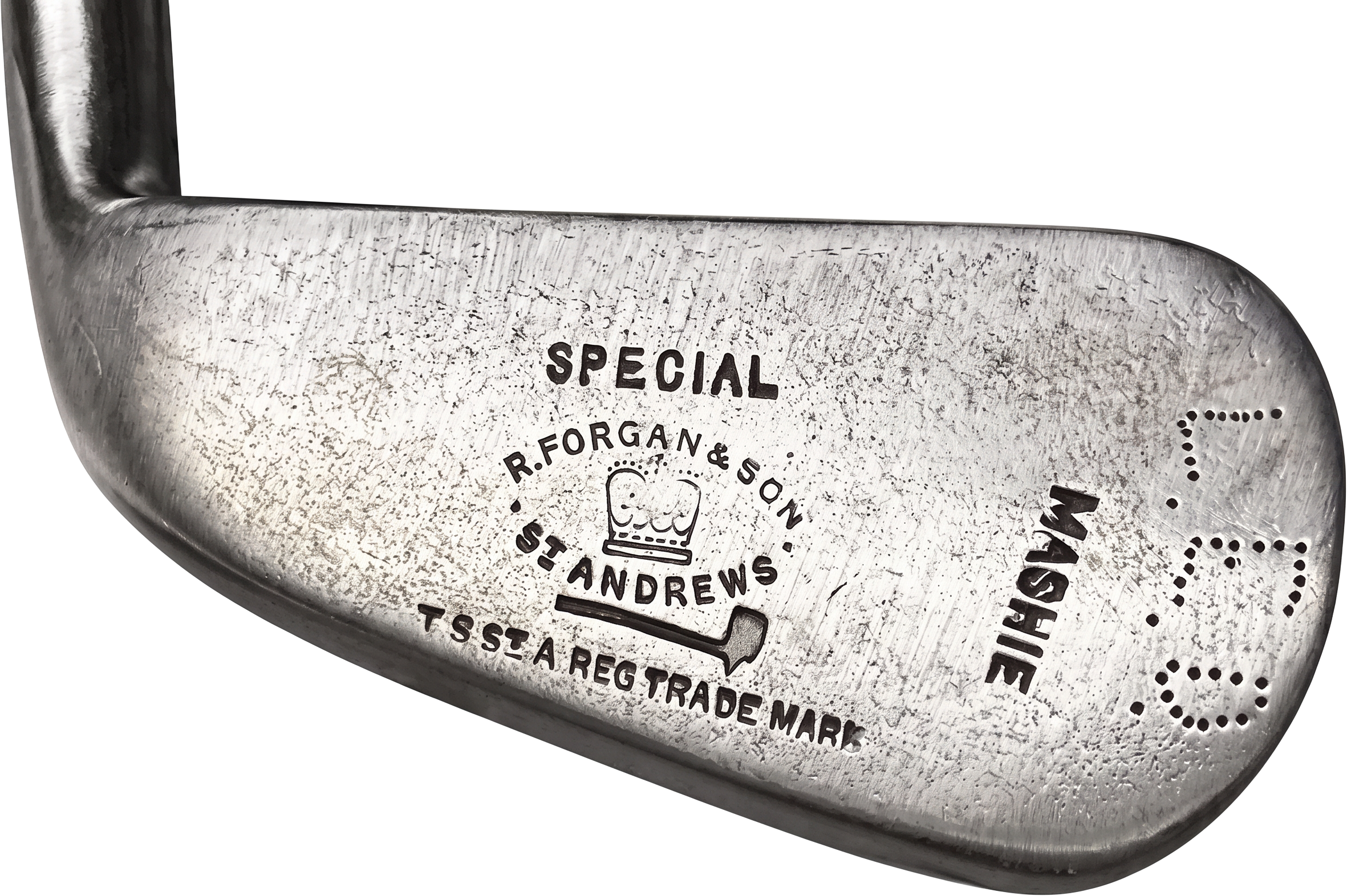
R. Forgan & Son “Special” Mashie, St Andrews, circa 1905–1909. Hand-forged iron bearing Forgan’s King’s Crown cleek mark and the dot-punched initials “L.E.D.,” probably those of its original owner. The King’s Crown (1901–c. 1909) and Stewart’s registered Pipe “Trade Mark” (from 1905) appearing together place this club at the end of the Edwardian era. Step 3
Read the maker's arc
Above the pipe you should find T. STEWART · MAKER · ST ANDREWS, often with SPECIAL and HAND FORGED IN SCOTLAND, and frequently T.S. ST A REG TRADE MARK below. Look closely at the letters: uneven depths and angles are the fingerprint of hand work.
T. Stewart · Maker · St Andrews · Throughout
- —Individual letters sit at slightly different depths and angles — this is hand work
- —Reads cleanly under low raking light, badly under a bright lamp
Watch for: Perfectly even lettering at a uniform depth is a machine, and a machine means somebody recent.
T. STEWART · MAKER · ST ANDREWS in the oval, SPECIAL and HAND FORGED IN SCOTLAND above, the pipe below. A 3 iron from my own bag. Tom Stewart “Special” No. 3 Iron, St Andrews, circa 1920–1925. A hand-forged Scottish hickory iron bearing Stewart’s registered pipe cleek mark, produced as golfers began moving from traditional club names toward numbered matched sets. Step 4
Note any retailer stamp
A shop or professional's name across the back — Auchterlonie, Anderson, Spalding, or a name like A. J. Miles — does not disqualify the club. Stewart supplied heads to the trade. Check that the shop name and the pipe sit at the same original depth and that neither is struck over the other.
Retailer stamps · Throughout
- —Retailer name and maker's pipe sit beside each other, both original depth
- —This is the normal case: Stewart sold heads to the trade by the crate
Watch for: Be wary when a shop name is struck over the pipe, or struck shallow on an otherwise worn head.
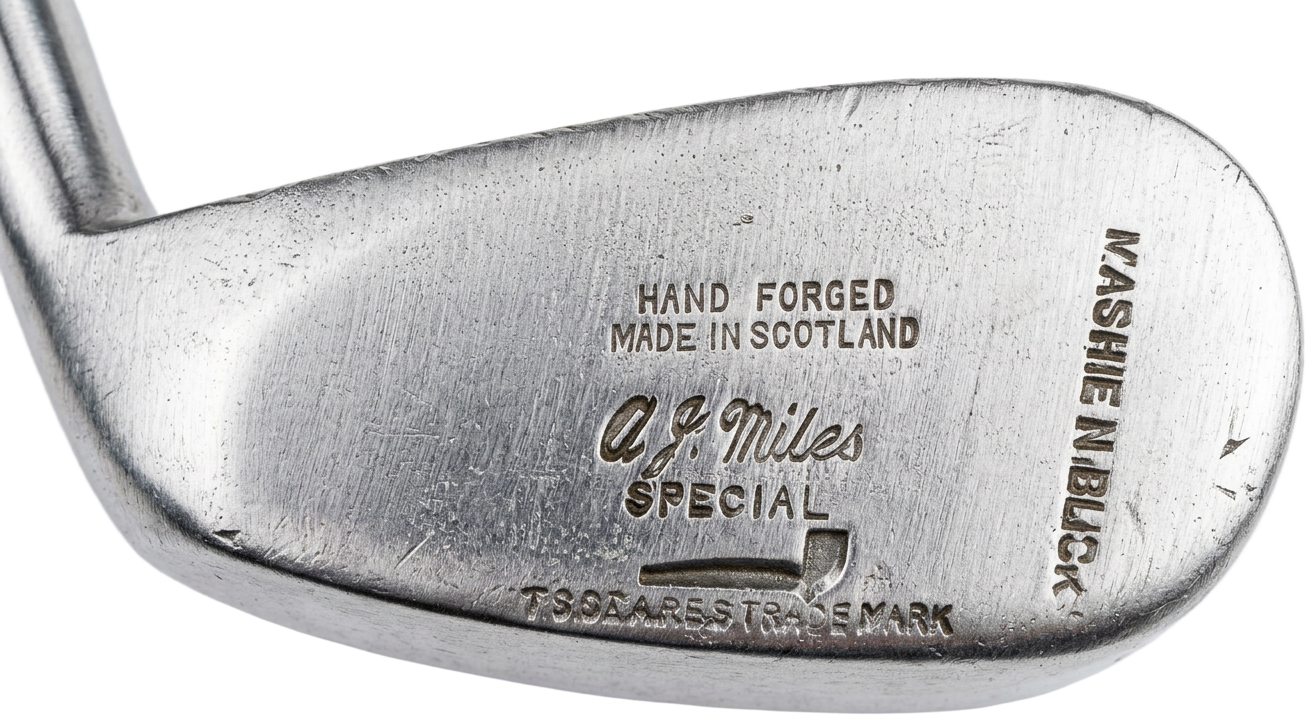
A. J. MILES SPECIAL over the pipe and T.S. ST A REG TRADE MARK — a mashie niblick sold through a professional's shop. Tom Stewart–made “A. J. Miles Special” Mashie Niblick, circa 1915–1925. Hand-forged in Scotland for professional or retailer A. J. Miles and bearing Stewart’s registered pipe cleek mark. Step 5
Check for bench numbers and Rustless
One or two hand-punched digits below the pipe are bench, die or weight-run marks — not serial numbers, whatever a listing tells you. Rustless stamped below a large pipe means a stainless head from the mid-1920s onward, which is why it looks so bright a century later.
Bench numbers · Throughout
- —Consistent hand and angle across a genuine matched set
- —Wandering digits usually mean a set assembled from several sources
Watch for: Widely read as bench, die or weight-run numbers rather than serial numbers. That reading is consensus, not documented fact.
Step 6
Read the face
Smooth faces into the 1900s, dot punching and deep corrugations through the late 1910s and early 1920s, plain lines after deep grooves were restricted. Original punching wears hollow in the strike zone and stays sharp at the toe. Run a fingernail across a suspiciously crisp deep-groove face.
Face patterns · Smooth → dot & corrugated → line
- —Original punching is worn hollow in the strike zone and sharp at the toe
- —Face pattern brackets a date more reliably than most people's pipe reading
Watch for: A crisp, evenly cruel deep-groove face is usually a modern re-cut. Run a fingernail across it.
Step 7
Bracket the date, then the club type
Combine what you have found into a range rather than a year. Then name the club: cleek, mid-iron, mashie, spade mashie, mashie-niblick, niblick — numbered irons only start appearing as the 1920s go on.
The large pipe · c. early 1920s – 1931
- —Deeper, broader strike that survives polishing better than the small pipe
- —Frequently accompanied by 'Rustless' on stainless heads
- —The mark on the great majority of surviving Stewart irons
Watch for: The changeover was gradual and the two overlap. Treat any single-year dating from the pipe alone as a guess.
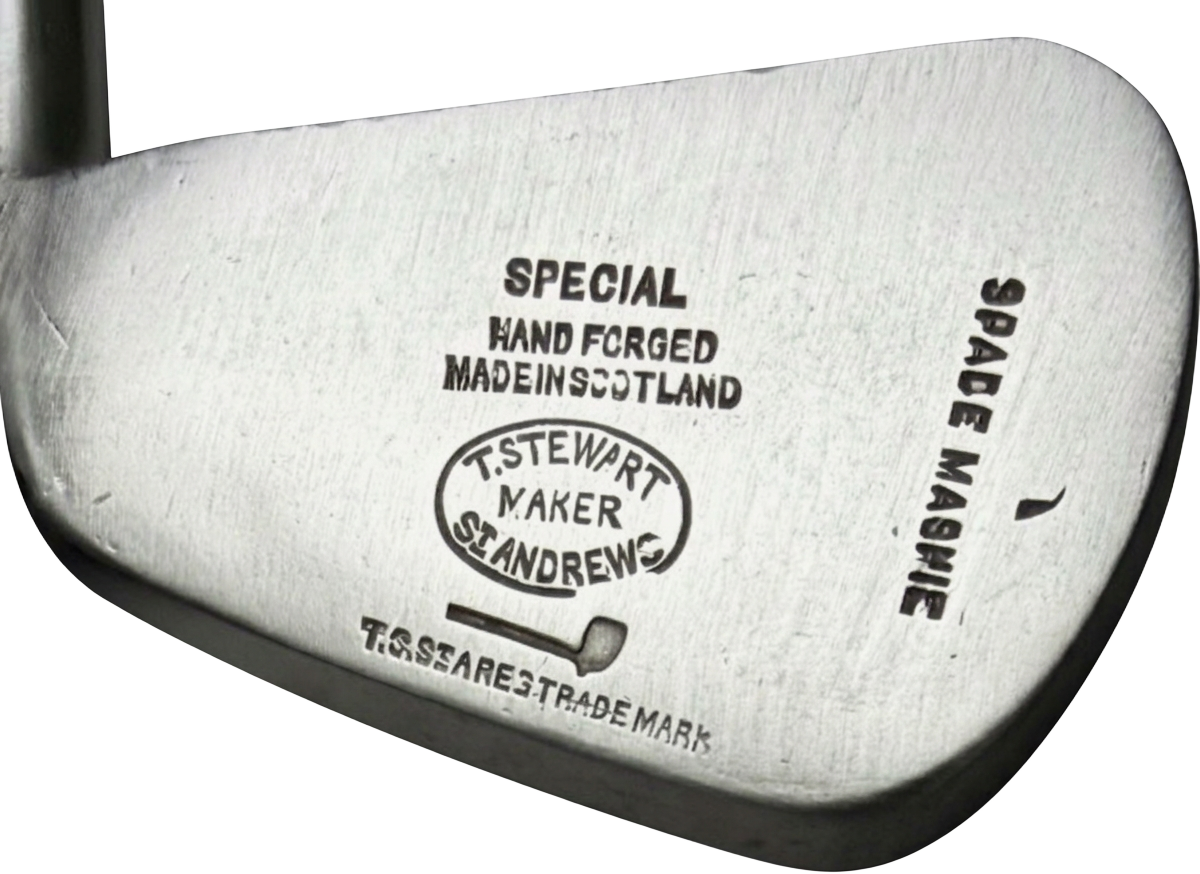
Tom Stewart “Special” Spade Mashie, St Andrews, circa 1915–1925. Hand-forged in Scotland and bearing Stewart’s registered pipe cleek mark. The Spade Mashie was a lofted approach club from the hickory era.
What should make you pause
- —Lettering of machine evenness, every character at the same depth.
- —A scarce serpent mark on a heavy, short, dot-punched 1920s blade.
- —A shop name struck over the pipe, or struck shallow on an otherwise worn head.
- —A face whose grooves are crisp and even where the strike zone is worn hollow.
- —A listing that dates a club to a single year from the pipe alone.
Common questions
- Where is the Tom Stewart mark on a club?
- On the back of the iron head, behind the hosel. Look for a small briar pipe struck in profile, usually beneath an arc reading T. STEWART · MAKER · ST ANDREWS, sometimes with a hand-punched bench digit below it.
- What is the difference between the small pipe and the large pipe?
- Bowl size, not stem length. The small pipe (c. 1905 to the early 1920s) has a bowl roughly the width of a match head. The large pipe (c. early 1920s to 1931) is nearer a pea and struck deeper and lower. The changeover was gradual, so treat any single-year dating from the pipe alone as a guess.
- My club says Auchterlonie or Spalding, not Stewart. Is it still a Stewart?
- Very likely yes. Stewart sold heads to the trade by the crate, so a retailer or professional's name arced above the pipe is the normal case, not a warning sign. What matters is that both stamps sit at the same original depth.
- How do I date a Tom Stewart iron?
- Bracket it from several signals at once: mark type, face pattern, presence of Rustless, club naming (names before numbers), and shaft and grip work. Face pattern brackets a date more reliably than most people's pipe reading.
- How can I tell a fake Tom Stewart stamp?
- Hand-struck lettering sits at slightly different depths and angles. Perfectly even lettering at a uniform depth is machine work, and a machine means somebody recent. Also be wary of a crisp deep-groove face — usually a modern re-cut — and of a scarce serpent mark on a heavy 1920s blade.