Cleek
2 iron / driving ironLoft roughly 18–22°
Long thin blade, shallow face, thin sole. Built to be run along the ground into wind rather than flown. The club the whole workshop's reputation was made on.
What came out of the shop
Stewart made iron heads and very little else — no woods, no novelty. The names below are the whole vocabulary, and the lofts are approximate because every head was finished by hand.
Loft roughly 18–22°
Long thin blade, shallow face, thin sole. Built to be run along the ground into wind rather than flown. The club the whole workshop's reputation was made on.
Loft roughly 15–18°
Less loft than the cleek and a touch heavier. Off firm links turf the ball never gets high enough for the wind to take it.
Loft roughly 24–27°
The workhorse. Head around 240 grams, flattish lie, and a face that on any honest old example is worn through in one square inch.
Loft roughly 28–31°
Sits between the mid-iron and the mashie. Less common, and often the missing club in an assembled set.
Loft roughly 32–37°
The most-made iron of the era and the one most likely to be dot-punched. If you own one Stewart club, statistically it is this.
Loft roughly 38–41°
Deeper, heavier blade for lifting the ball out of thicker lies without the full niblick's bluntness.
Loft roughly 42–45°
The pitching club. Short shaft, compact head, and the club most often re-shafted because it got the most use.
Loft roughly 46–55°
Small round head, heavy for its size, no bounce to speak of. Bunker play with one of these is a skill, not a technique.
Loft roughly 25–30°
Short blade, heavy sole, long-iron loft on a short shaft. One club for every bump-and-run inside seventy yards, and the reason nobody needed a lob wedge.
Loft 2–4°
Stewart blade putters are plainer than the irons and usually less marked. Check the hosel: the shaft-to-head joint is where a century of rolling shows first.
Lofts and weights were bent and ground to order in the professional's shop, so two irons of the same name from the same year can differ by several degrees. Measure the club in front of you, not the chart.
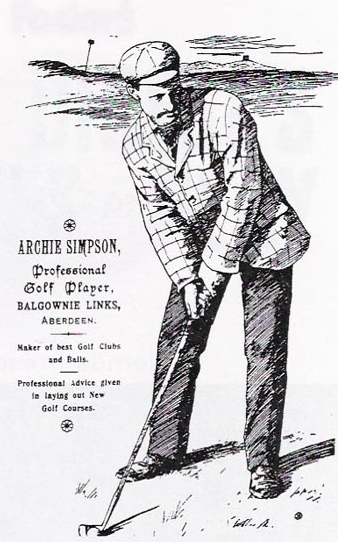
How the trade advertised itself
How a Scottish maker advertised himself in Stewart's working years: maker of best golf clubs and balls, advice given on laying out new courses.
Public domain; source: Wikimedia Commons · source page
more from the era →