Every Tom Stewart iron carries its own paperwork, struck into the back of the head by hand. This is what each mark looks like, roughly when it was used, and where the received wisdom is thinner than people admit.
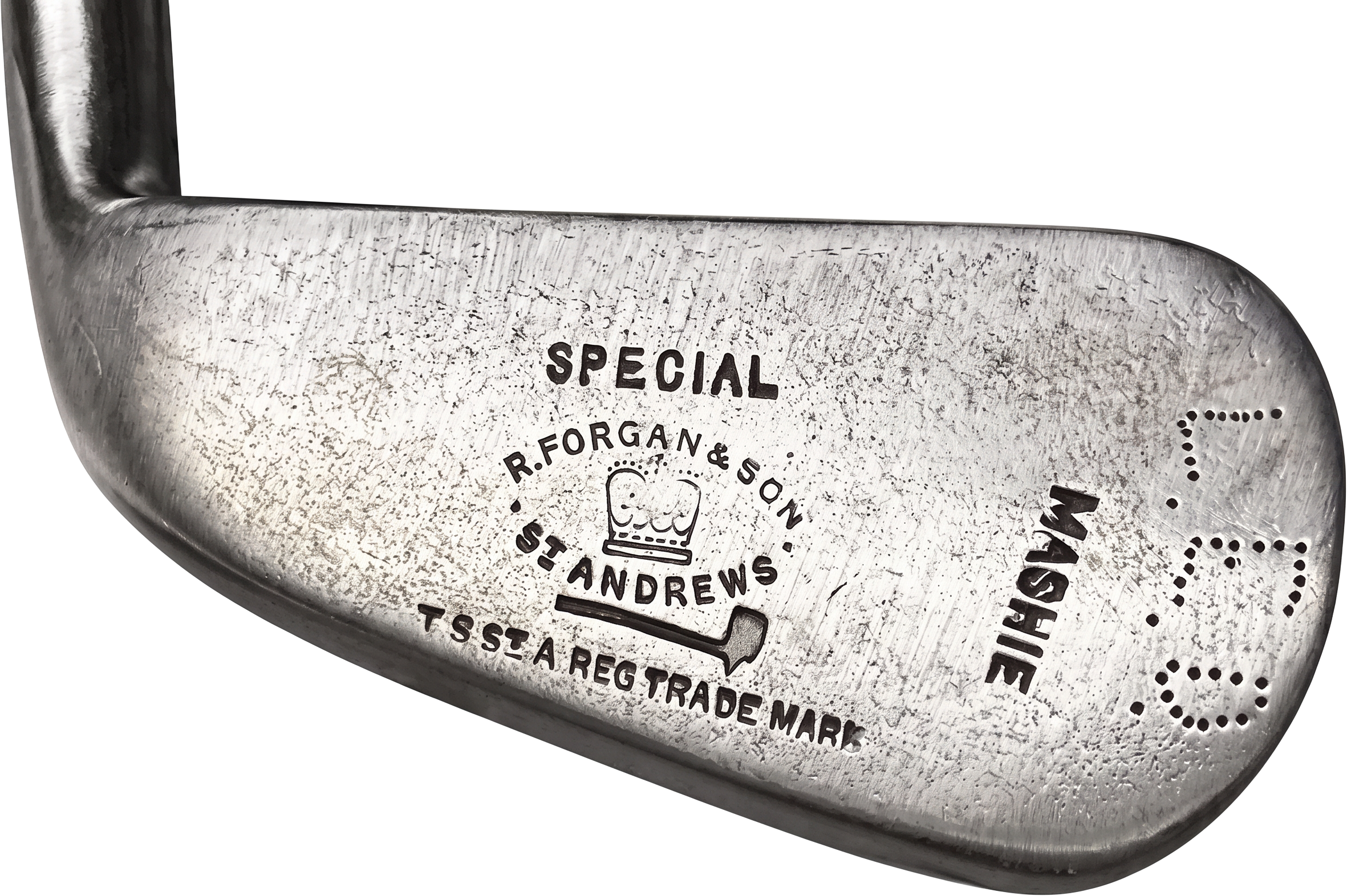
R. Forgan & Son “Special” Mashie, St Andrews, circa 1905–1909. Hand-forged iron bearing Forgan’s King’s Crown cleek mark and the dot-punched initials “L.E.D.,” probably those of its original owner.
The King’s Crown mark (1901–c. 1909): Robert Forgan & Son was appointed official clubmaker to HRH King Edward VII. In 1901 they changed their company crest from a three-feather plume to the King’s Crown, and used this crown mark on their irons until about 1909.
The Pipe Mark with “Trade Mark” (from 1905): the iron head itself was forged for Forgan by Tom Stewart, the most famous cleekmaker in St Andrews. Stewart used a clay pipe symbol as his personal mark from 1893, but only registered it as an official trademark and added the small text “Trade Mark” underneath from 1905.
Because this club carries both the King’s Crown (which phased out around 1909) and the registered Pipe “Trade Mark” text (which began in 1905), it sits right at the end of the Edwardian era.
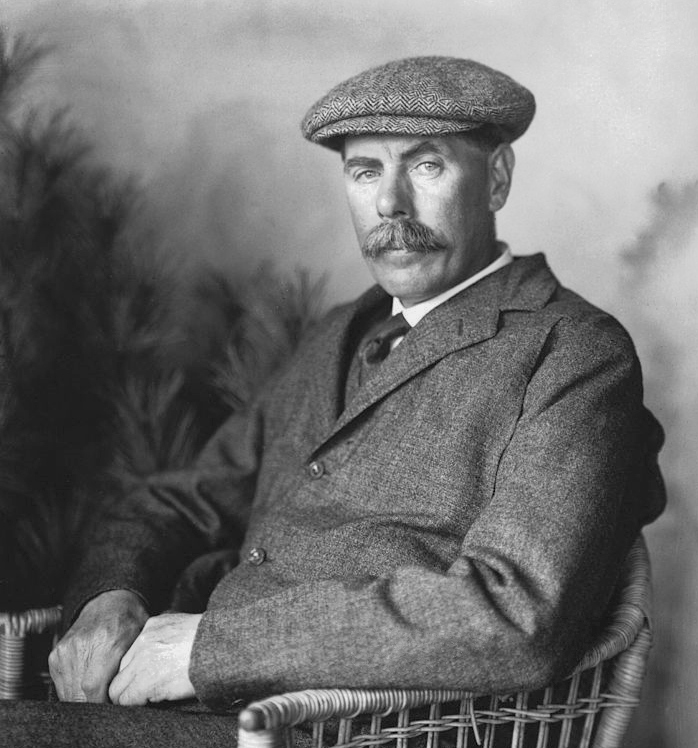
James Braid, 1904
Braid, of the Great Triumvirate, is another name attached to Stewart clubs held in museum collections.
Public domain; source: Wikimedia Commons · source page
The serpent
c. 1893 – c. 1905
A small coiled serpent struck beneath the arc of lettering, on heads made before the pipe became the workshop's signature.
—Sits high on the back, close under the arc rather than behind the hosel
—Almost always paired with a smooth face and a long, thin blade
—Lettering is finer and more crowded than on later heads
Watch for: Genuinely scarce. A serpent on a heavy, short, dot-punched 1920s blade is the wrong mark on the wrong club.
Photograph wanted — no example of this mark in hand yet.
The small pipe
c. 1905 – early 1920s
A briar pipe in profile, bowl roughly the width of a match head, stem running to the right. The mark most collectors mean when they say 'pipe brand'.
—Bowl small and shallow; the stem is the first part to wear away
—Struck behind the hosel, usually with a hand-punched bench digit below
—Commonly found with smooth or lightly dot-punched faces
Watch for: Bowl size is the reading, not stem length. A worn stem tells you nothing; a small bowl on a low strike does.
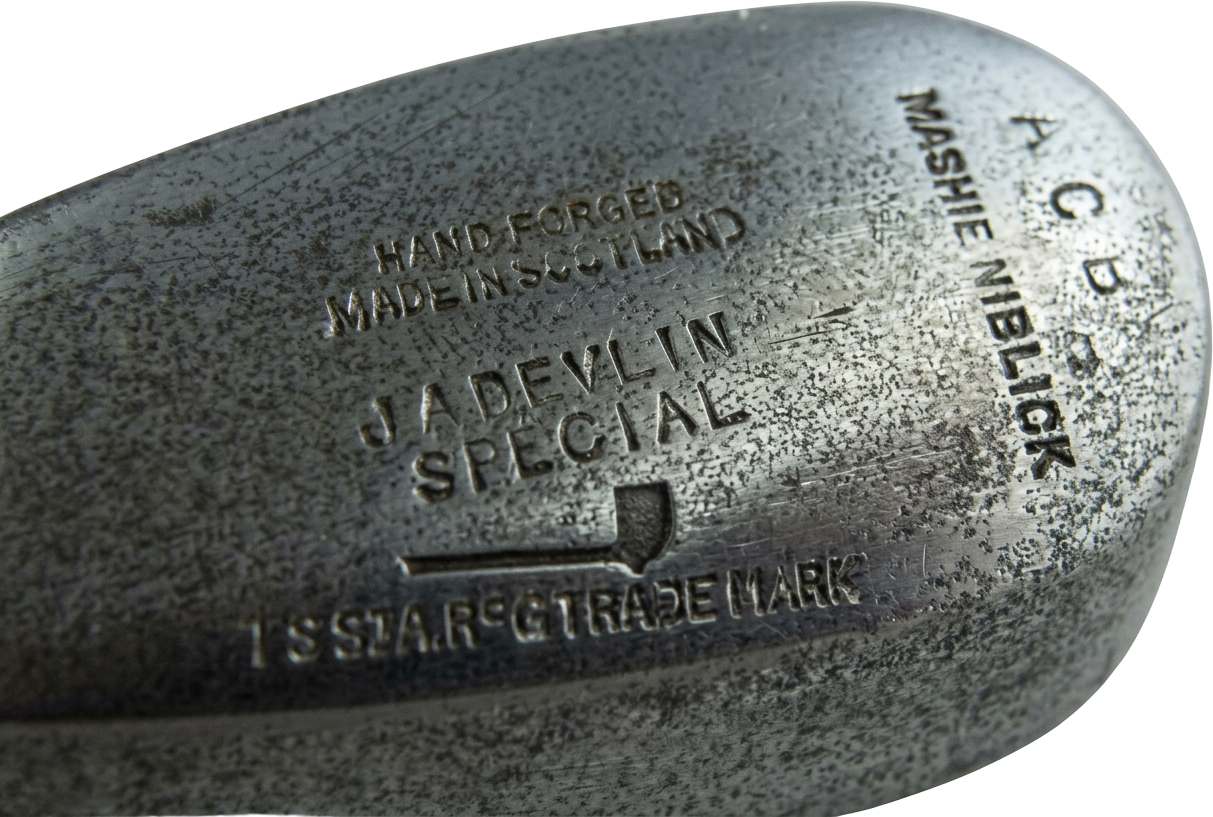
R. Forgan & Son “Special” Mashie, St Andrews, circa 1905–1909. Hand-forged iron bearing Forgan’s King’s Crown cleek mark and the dot-punched initials “L.E.D.,” probably those of its original owner. The King’s Crown (1901–c. 1909) and Stewart’s registered Pipe “Trade Mark” (from 1905) appearing together place this club at the end of the Edwardian era.A c. 1910 mashie niblick stamped J. A. DEVLIN SPECIAL with HAND FORGED MADE IN SCOTLAND above, the pipe struck low and T.S. ST A REG TRADE MARK beneath it. The photograph shows the arrangement; bowl size is still judged in the hand.
The large pipe
c. early 1920s – 1931
The same pipe, noticeably bigger — bowl nearer the size of a pea — and set lower and further from the hosel.
—Deeper, broader strike that survives polishing better than the small pipe
—Frequently accompanied by 'Rustless' on stainless heads
—The mark on the great majority of surviving Stewart irons
Watch for: The changeover was gradual and the two overlap. Treat any single-year dating from the pipe alone as a guess.
Contested among collectors — treat the dating as a bracket, not a fact.
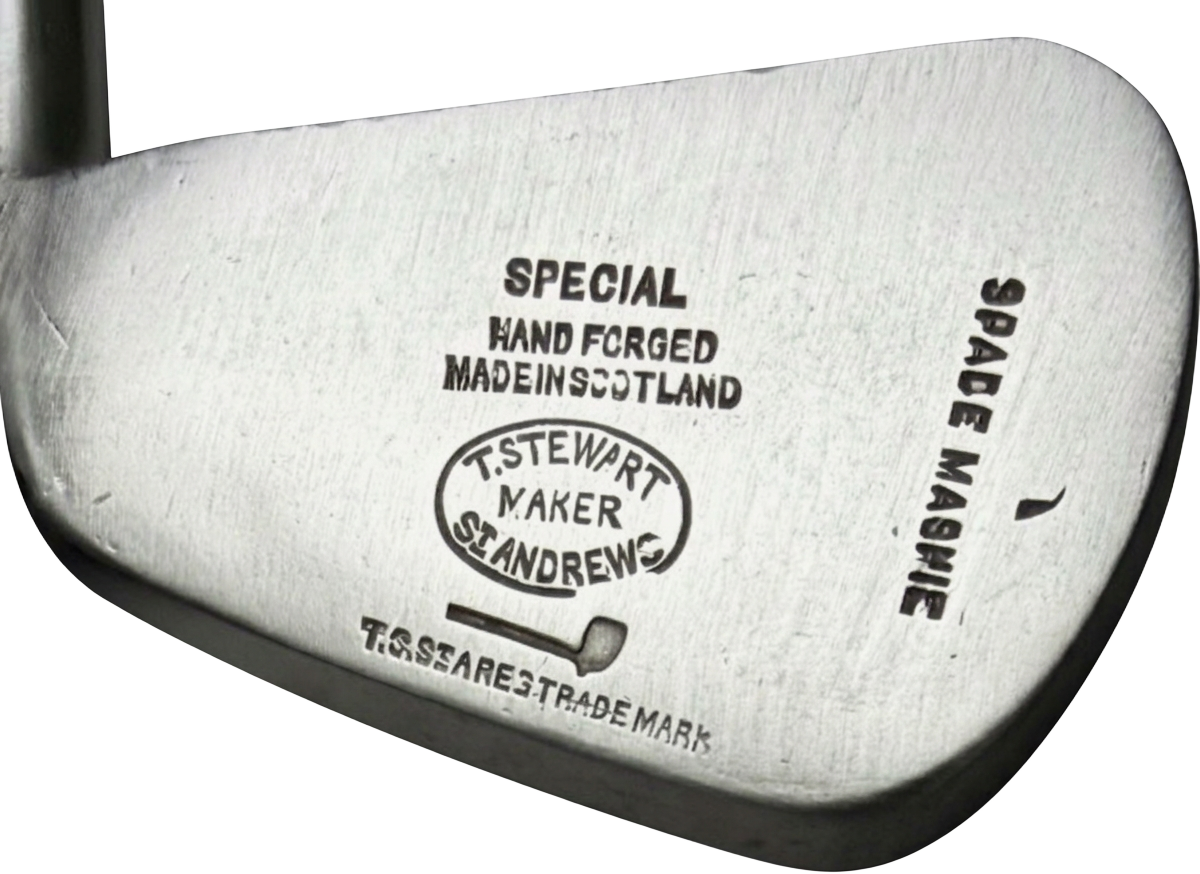
Tom Stewart “Special” Spade Mashie, St Andrews, circa 1915–1925. Hand-forged in Scotland and bearing Stewart’s registered pipe cleek mark. The Spade Mashie was a lofted approach club from the hickory era.
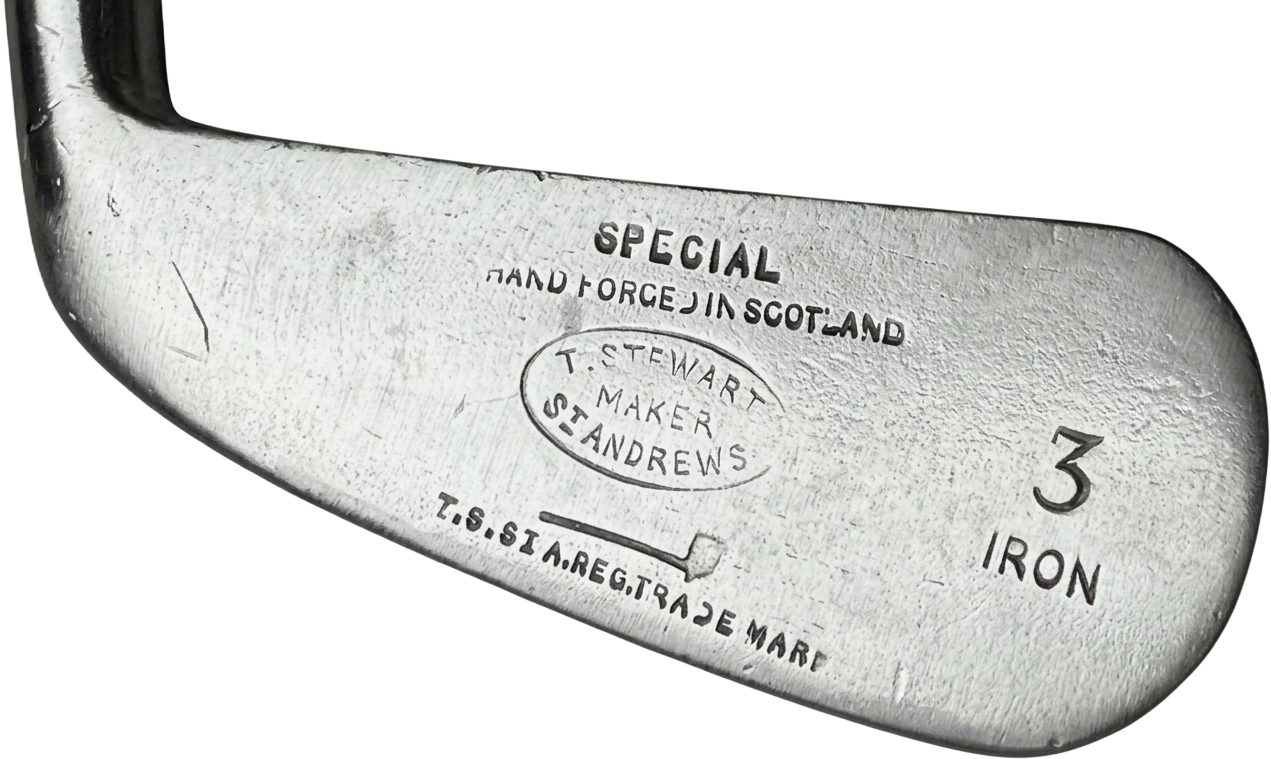
T. Stewart · Maker · St Andrews
Throughout
The maker's arc, struck letter by letter above the pipe. On worn heads it survives as a faint curve of disturbed grain.
—Individual letters sit at slightly different depths and angles — this is hand work
—Reads cleanly under low raking light, badly under a bright lamp
Watch for: Perfectly even lettering at a uniform depth is a machine, and a machine means somebody recent.
T. STEWART · MAKER · ST ANDREWS in the oval, SPECIAL and HAND FORGED IN SCOTLAND above, the pipe below. A 3 iron from my own bag. Tom Stewart “Special” No. 3 Iron, St Andrews, circa 1920–1925. A hand-forged Scottish hickory iron bearing Stewart’s registered pipe cleek mark, produced as golfers began moving from traditional club names toward numbered matched sets.The same oval on a spade mashie — note how the letters sit at slightly different depths where the punch was walked round by hand.
Rustless
c. mid 1920s – 1931
Stamped below the large pipe on the workshop's stainless heads.
—Bright metal with little or no pitting after a century
—Almost always paired with the large pipe and a plain line face
Watch for: Condition here is alloy, not care. Do not pay a preservation premium for something the steel did by itself.
Photograph wanted — no example of this mark in hand yet.
Retailer stamps
Throughout
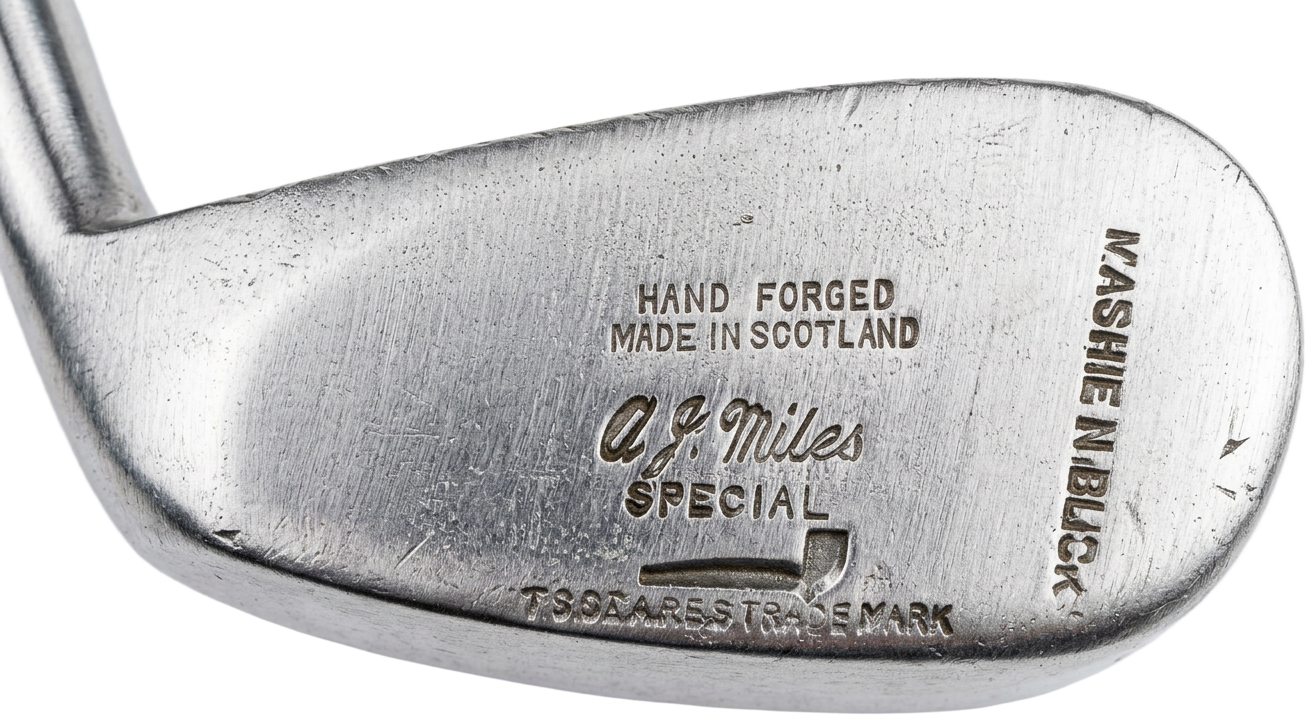
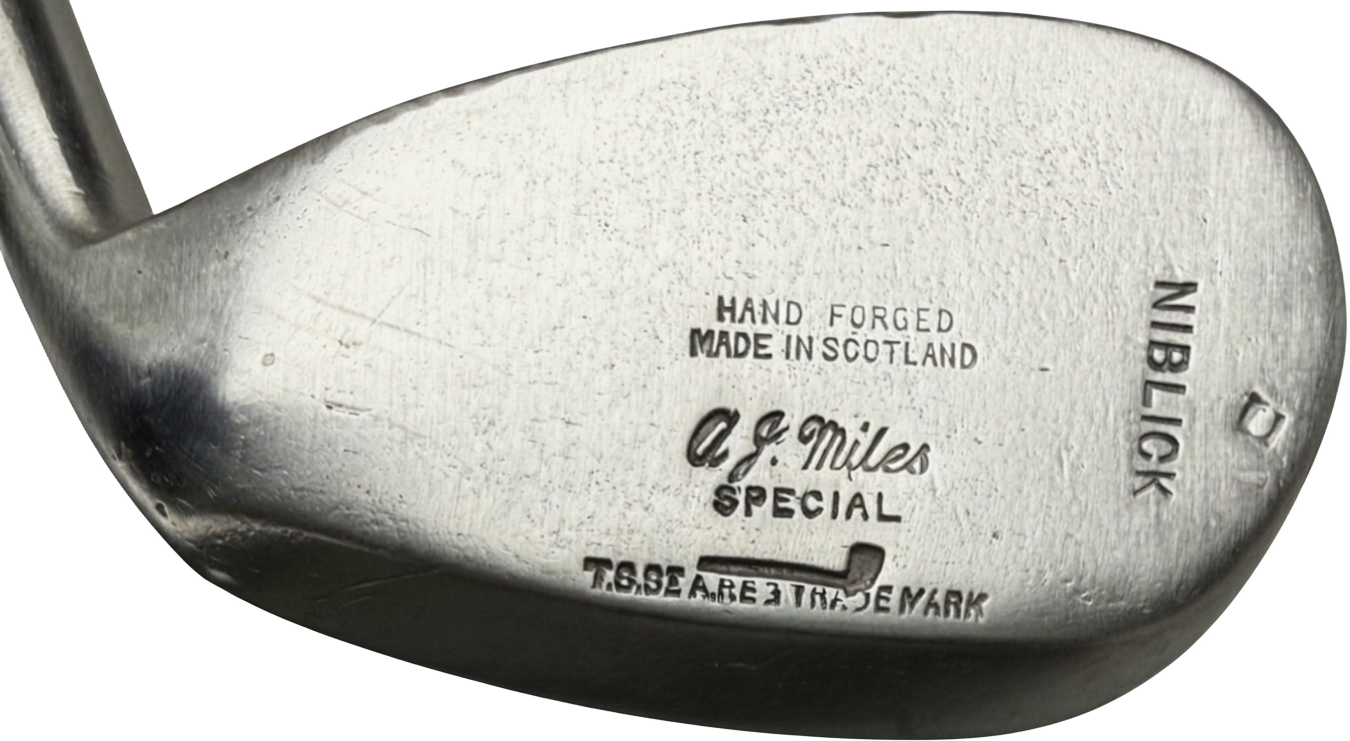
Auchterlonie, Anderson, Spalding, MacGregor, Wright & Ditson and dozens of professionals' shops, arced across the back of a Stewart head.
—Retailer name and maker's pipe sit beside each other, both original depth
—This is the normal case: Stewart sold heads to the trade by the crate
Watch for: Be wary when a shop name is struck over the pipe, or struck shallow on an otherwise worn head.
A. J. MILES SPECIAL over the pipe and T.S. ST A REG TRADE MARK — a mashie niblick sold through a professional's shop. Tom Stewart–made “A. J. Miles Special” Mashie Niblick, circa 1915–1925. Hand-forged in Scotland for professional or retailer A. J. Miles and bearing Stewart’s registered pipe cleek mark.The same shop stamp on a niblick, HAND FORGED MADE IN SCOTLAND above — a Tom Stewart of St Andrews hand-forged A. J. Miles Special niblick, registered pipe mark, likely c. 1925–1928, with factory inspection punch. Both clubs are from my own bag.
Bench numbers
Throughout
One or two hand-punched digits below the pipe.
—Consistent hand and angle across a genuine matched set
—Wandering digits usually mean a set assembled from several sources
Watch for: Widely read as bench, die or weight-run numbers rather than serial numbers. That reading is consensus, not documented fact.
Contested among collectors — treat the dating as a bracket, not a fact.
Photograph wanted — no example of this mark in hand yet.
Face patterns
Smooth → dot & corrugated → line
Smooth into the 1900s, dot punching and deep corrugations through the late 1910s and early 1920s, plain lines after the governing bodies restricted deep grooves.
—Original punching is worn hollow in the strike zone and sharp at the toe
—Face pattern brackets a date more reliably than most people's pipe reading
Watch for: A crisp, evenly cruel deep-groove face is usually a modern re-cut. Run a fingernail across it.
Photograph wanted — no example of this mark in hand yet.
Tom Stewart cleek marks: the questions collectors ask
How do I date a Tom Stewart club?
Read the mark behind the hosel, then the face. The serpent belongs to the earliest years, roughly 1893 to 1905. The small pipe carries you from about 1905 into the early 1920s — and the “Trade Mark” lettering beneath the pipe only appears from 1905, when the mark was registered. The large pipe, its bowl the size of a pea, runs from the early 1920s until Stewart’s death in 1931. The face helps too: smooth, then dot-punched, then plain again when deep grooves were outlawed. Where the dating is contested — the small-to-large pipe changeover above all — this archive says so rather than inventing a year.
What cleek marks did Tom Stewart use?
Three of his own: the serpent (c. 1893 – c. 1905), the small pipe (c. 1905 – early 1920s) and the large pipe (c. early 1920s – 1931), each struck beneath the hand-punched arc “T. Stewart · Maker · St Andrews”. Stainless heads may add “Rustless”. The professional shops that sold his heads — Forgan, Devlin, Miles and others — stamped their own names beside his, which is why the same pipe appears under many different shop names.
Why does my Stewart iron carry somebody else’s name?
Because that is how the trade worked. Stewart forged heads by the crate and sold them to professionals across Britain and America, who shafted them and stamped their own shop name on the back. It is not a fake — the pipe behind the hosel is the part that tells you who actually made it.
Take it to the workshop wall
The cleek-mark poster
The archive condensed into a researched A3 field guide, with uncertainty left visible.